

The best LMS for financial services tracks compliance automatically, produces audit-ready reports, and meets strict security standards. Here are the top 7 platforms compared for 2026.
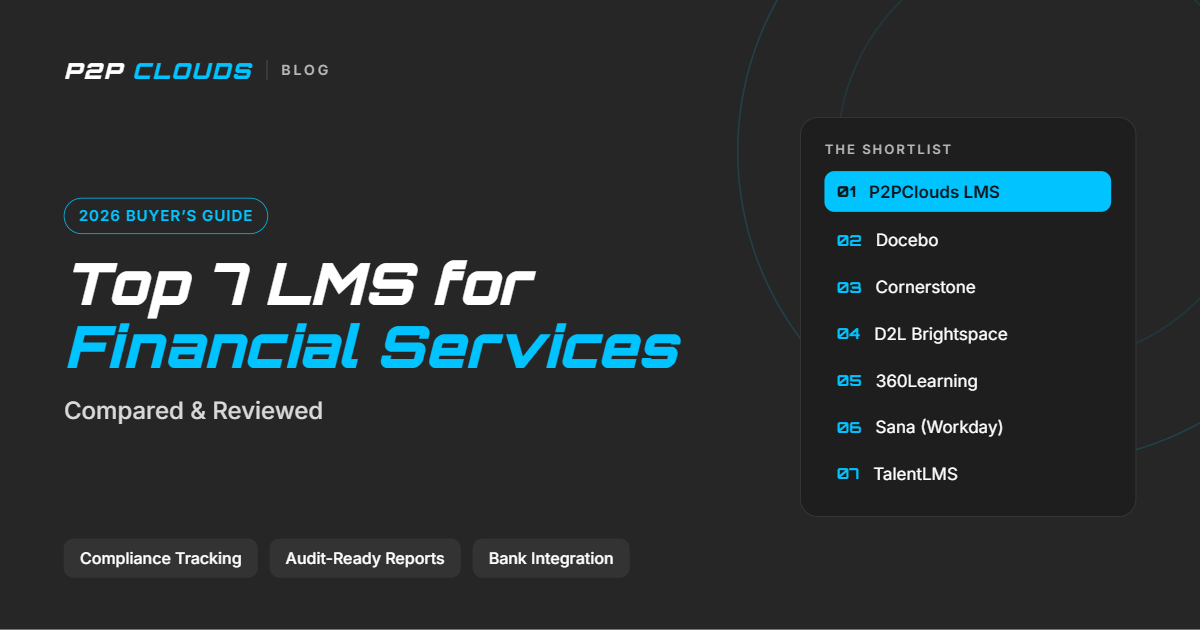
The best LMS for financial services is one that tracks compliance training automatically, produces audit-ready reports, and meets strict security standards. Banks, credit unions, insurance firms and wealth management companies all train staff on fast-changing rules. That’s why a dedicated LMS built for compliance works better than spreadsheets or generic course platforms.
In this guide, we compare the 7 leading LMS for financial services in 2026. You will see what each platform is best for, its key features, pros and cons, and pricing. We also share a checklist to help you choose the right one.
Quick answer: For large global banks, Cornerstone and Docebo are proven choices. For mid-sized firms that want fast setup, TalentLMS and 360Learning work well. For institutions that want an affordable platform with two-way bank integration and unlimited learners, P2PClouds LMS is a strong fit.
Disclosure: P2PClouds LMS is our own platform. We have tried to review every product fairly, including our own.
An LMS solves five problems that financial institutions face every year: compliance risk, audit pressure, slow onboarding, scattered teams and data security.
Compliance risk. Staff must complete training on rules such as AML (anti-money laundering), KYC (know your customer), SOX, GLBA and FINRA requirements. An LMS assigns these courses automatically and sends reminders before deadlines.
Audit pressure. Regulators such as the SEC, FINRA and FFIEC examiners expect proof of training. An LMS keeps a timestamped record of who completed what, so audit reports take minutes instead of weeks.
Slow onboarding. New tellers, loan officers and financial advisors need role-specific training before they serve customers. Learning paths get them productive faster.
Scattered teams. Branch staff, remote advisors and head-office teams all need the same training. A cloud LMS with mobile access reaches everyone.
Data security. Training records contain employee data. A good LMS protects it with encryption, single sign-on (SSO) and role-based access.
The must-have features are compliance automation, audit reporting and enterprise-grade security. Everything else is a bonus.
Compliance tracking and automation The LMS should assign mandatory courses by role, set recurring deadlines (for example, annual AML refreshers) and escalate overdue training to managers.
Audit-ready reporting Look for exportable completion reports, timestamps, quiz scores and certificate history. You should be able to answer an examiner's question in one click.
Certifications and CE credits Financial advisors and insurance agents must earn continuing education (CE) credits. A good LMS tracks these credits and issues certificates automatically, saving advisors time.
Security and data protection Ask for SOC 2 Type II or ISO 27001 certification, data encryption, SSO and role-based permissions. US banks will ask about these on the first call.
Role-based learning paths Tellers, loan officers, compliance officers and wealth advisors need different training. Learning paths deliver the right courses to each role.
Integrations The LMS should connect to your HR system (such as Workday or SAP), your identity provider and tools like Microsoft Teams or Slack.
Mobile learning Branch and field staff rarely sit at a desk. A mobile app or responsive design lets them train anywhere.
AI-powered personalization Modern platforms use AI to recommend courses, generate quizzes and spot skill gaps. This saves admins hours every week.
Here are the top LMS for financial services, with what each one does best. Prices were checked in October 2026 and may change.
Best for: Small and mid-sized financial institutions that want an affordable LMS with two-way bank integration and unlimited learners.
P2PClouds LMS is a mature learning platform trusted by institutions for 7+ years, with 20,000+ learners trained across Pakistan and the UAE. It is used by organizations such as Nexskill, Ideoversity and PSDF, and runs with 99.9% platform uptime. Its standout feature for finance teams is two-way integration with banks, so payment and training data stay in sync without manual work.
Key features:
Pros:
Cons:
Pricing: Starter $10/month, Growth $40/month, Enterprise $540/month, and Custom plans on request. You can get started free.
Best for: Mid-to-large financial firms that want AI-driven learning and a modern interface.
Docebo is a leading enterprise LMS with a dedicated financial services solution. It uses AI to tag content, recommend courses and personalize learning.
Key features: AI-powered content creation and recommendations; compliance and certification management; extended enterprise training for partners and clients; large integration marketplace.
Pros: Strong AI and automation; scales well for global teams.
Cons: Expensive for smaller firms; setup can take weeks.
Pricing: Custom quote.
👉 Visit Docebo for financial services
Best for: Large global banks that need learning tied closely to HR and talent management.
Cornerstone is one of the most established names in enterprise learning. Its financial services offering focuses on regulatory compliance and talent development at scale.
Key features: Deep compliance tracking and audit reporting; integration with HR systems like Workday and SAP; skills and talent management tools; large content library.
Pros: Trusted by major global financial institutions; very complete feature set.
Cons: Complex to configure and administer; overkill and costly for smaller firms.
Pricing: Custom quote.
👉 Visit Cornerstone for financial services
Best for: Institutions that want strong course design and analytics.
D2L Brightspace started in education and now serves corporate teams, including banks. It is known for clean course design and detailed learner analytics.
Key features: Flexible course authoring; detailed analytics and reporting; accessibility-focused design; mobile learning.
Pros: Excellent learner experience; strong reporting.
Cons: Fewer finance-specific compliance tools out of the box; pricing is not public.
Pricing: Custom quote.
Best for: Teams that want collaborative learning, where internal experts create courses quickly.
360Learning lets subject-matter experts build and update training themselves. This helps finance teams keep compliance content current as rules change.
Key features: Collaborative course authoring; AI-assisted course creation; peer feedback and reactions; analytics and reporting.
Pros: Fast content creation; transparent starting price.
Cons: Per-user pricing grows quickly with headcount; less focused on regulated industries than some rivals.
Pricing: From $8 per user per month for the Team plan (up to 100 users); Business and Enterprise are custom.
Best for: Enterprises already on Workday that want AI-native learning and knowledge search.
Workday completed its acquisition of Sana in November 2025. Sana combines AI search, AI agents and learning in one platform.
Key features: AI-generated courses and assistants; enterprise knowledge search; integration with Workday data.
Pros: Cutting-edge AI; natural fit for Workday customers.
Cons: Product direction is shifting after the acquisition; best value only inside the Workday ecosystem.
Pricing: Custom quote.
👉 Read Sana's guide to finserv LMS
Best for: Small and mid-sized firms that want a simple LMS with published pricing.
TalentLMS is one of the easiest LMS platforms to set up. It has a dedicated financial services page and transparent plans.
Key features: Simple course builder; automations for course assignment; SSO on all paid plans; custom reports on higher plans.
Pros: Very easy to use; clear, published pricing.
Cons: Fewer advanced compliance features than enterprise tools; key features locked to higher tiers.
Pricing: From $119 per month billed yearly (Core plan).
Use this table to shortlist 2–3 platforms before booking demos.
| LMS | Best for | Standout strength | Starting price |
|---|---|---|---|
| P2PClouds LMS | Small and mid-sized institutions | Two-way bank integration, unlimited learners | $10/month |
| Docebo | Mid-to-large firms | AI-driven personalization | Custom quote |
| Cornerstone | Large global banks | HR and talent integration | Custom quote |
| D2L Brightspace | Course design and analytics | Learner experience | Custom quote |
| 360Learning | Fast internal course creation | Collaborative authoring | $8/user/month |
| Sana (Workday) | Workday customers | AI-native learning and search | Custom quote |
| TalentLMS | Simple setup on a budget | Ease of use | $119/month (yearly) |
The right LMS is the one that passes your compliance, security and budget checks. Ask every vendor these 10 questions before you sign:
Tip: Shortlist 2–3 vendors, run a trial with one team, and compare admin time and completion rates before you decide.
Which LMS is best for the finance industry? It depends on your size. Cornerstone and Docebo suit large banks with complex compliance needs. TalentLMS and 360Learning suit mid-sized teams that want fast setup. P2PClouds LMS suits institutions that want an affordable LMS with two-way bank integration, starting at $10 per month.
What is the best LMS for banking? The best LMS for banking automates compliance training, keeps audit-ready records and meets security standards like SOC 2. Cornerstone and Docebo are common choices for large banks, while smaller banks and credit unions often prefer simpler, lower-cost platforms.
What main issues does an LMS solve for financial services? An LMS automates compliance training, produces proof of training for audits, speeds up onboarding and delivers consistent training to branch and remote staff.
How much does an LMS for financial services cost? Published plans start at $10 per month with unlimited learners (P2PClouds LMS), $8 per user per month (360Learning) or $119 per month (TalentLMS). Enterprise platforms like Cornerstone and Docebo use custom quotes, priced for larger organizations.
Is SOC 2 certification required for a financial services LMS? It is not a legal requirement, but most US banks and financial firms expect it from vendors that store employee data. Always ask for a current SOC 2 Type II report.
Can an LMS track continuing education (CE) credits? Yes. Many LMS platforms track CE credits for financial advisors and insurance agents and issue certificates automatically. Confirm this during your demo.
The best LMS for financial services is the one that keeps you audit-ready without slowing your team down. Large banks will get the most from Cornerstone or Docebo. Smaller and mid-sized institutions should look for a platform that balances compliance features, security and cost.
See how P2PClouds LMS can automate compliance training, track certifications and save your admins hours every week.
👉 Start your free trial at lms.p2pclouds.net
Plans start at $10/month with unlimited learners. Questions? Email us at info@p2pclouds.net.