Turn spreadsheets into thousands of search-optimized WordPress pages. Upload your data, define a template, and let AI generate unique content for every row — published natively through WordPress.

P2PForge
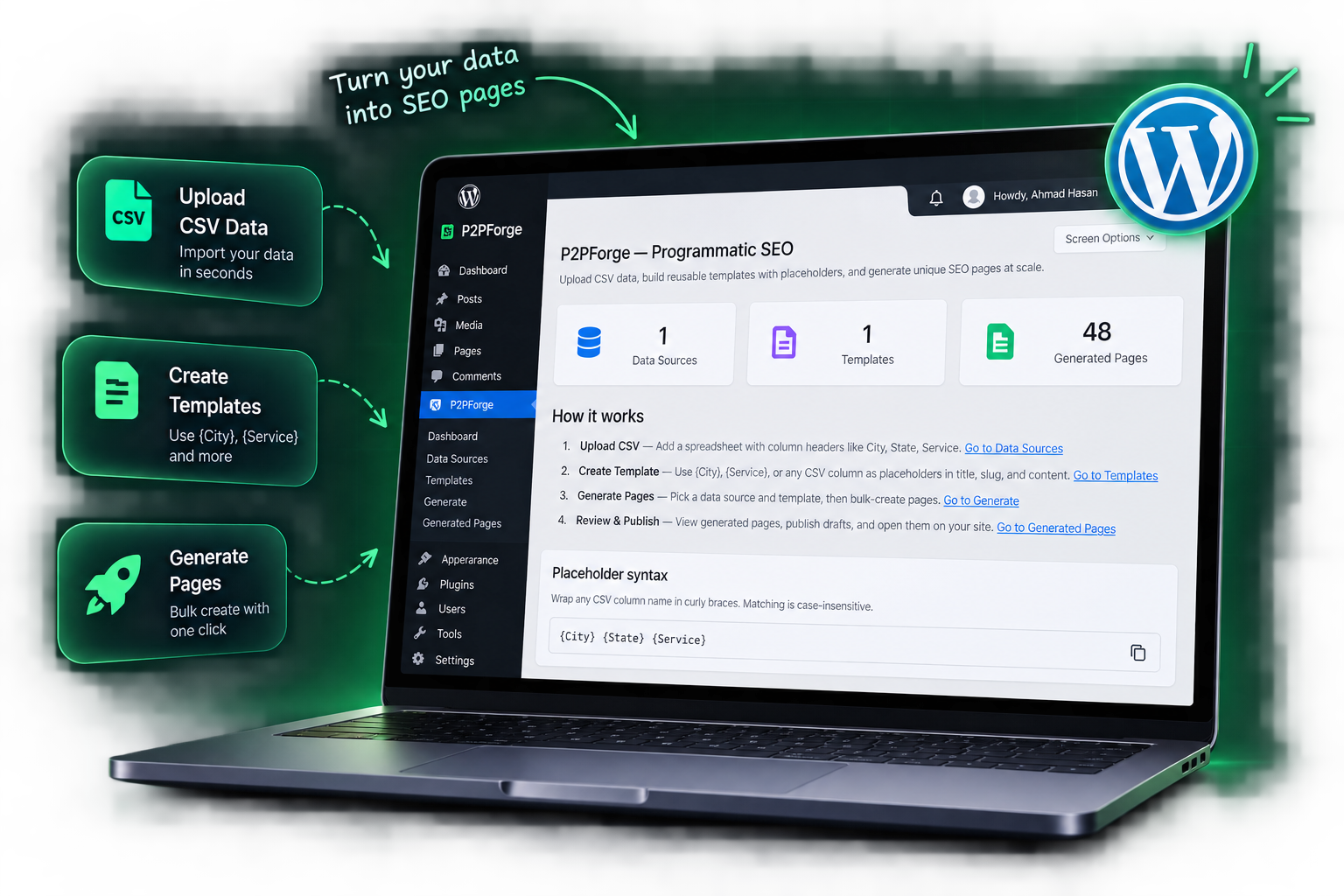
Connect your WordPress site, upload your data, and generate unique SEO-ready pages — written directly into WordPress.
Everything you need to generate and publish programmatic SEO pages on WordPress — safely, at scale, without writing each page by hand.
Native WordPress publishing through the post API
AI content per row, not per template
CSV in, pages out — upload and map columns without code
Manage multiple WordPress sites from one dashboard
Use CSV or Google Sheets as your data source
AI fills content gaps with genuinely unique copy per page
Every page lands as a draft — review before publishing
Built for quality at scale, not thin duplicate pages
The plugin connects your WordPress site to the platform. It doesn't generate content itself — it publishes what your account sends it, natively, as real WordPress posts.
Questions
Is programmatic SEO bad for Google rankings?
Not inherently. Google penalizes thin, low-value, duplicate-intent pages — not the act of generating pages from a template. Sites like Zillow and TripAdvisor run almost entirely on programmatic pages and rank extremely well, because each page answers a genuinely distinct query with real, specific information.
How many pages can I generate at once?
Technically, thousands in a single batch. Practically, you should publish in controlled drips rather than all at once — a sudden spike of thousands of new pages looks unnatural to search engines and is harder to quality-check. A queued, rate-limited rollout is safer than a single bulk dump.
Do I need to know how to code to use programmatic SEO?
No. The data side is a spreadsheet (CSV or Google Sheet), and the page-building side is a template with placeholders. P2PForge handles the generation and publishing without requiring you to write code.
What's the difference between programmatic SEO and just writing more blog posts?
Blog posts are written one at a time, usually targeting one keyword each. Programmatic SEO defines one template and one data source, then generates a unique page per row — so 500 rows of city/service data becomes 500 distinct, individually targeted pages without writing each one by hand.