How sites like Zillow and TripAdvisor turned spreadsheets into millions of search-ranked pages — and how to do it on WordPress without creating digital junk.
The Basics
Programmatic SEO is the practice of generating a large number of search-optimized pages from a single template and a structured data source, instead of writing each page by hand. One template plus a spreadsheet of 500 cities becomes 500 unique, individually targeted landing pages.
Traditional SEO is one page, one writer, one keyword, repeated as many times as you have the hours for. Programmatic SEO swaps that for one well-built template and a dataset — the template defines the structure, the data defines what makes each page genuinely different.
Zillow
A page per neighborhood, in every city it covers.
TripAdvisor
A page per attraction, restaurant, and city pairing.
Yelp
A page per business category, per location.
The Mechanics
Your data source
A CSV or Google Sheet — cities, services, products, categories, whatever your pages are organized around.
Your template
One page structure with placeholders — title, body, meta description — that the data fills in per row.
AI fills the gaps
Each row gets genuinely unique content generated around it, not the same paragraph with the city name swapped.
Pages go live
Published directly to your site as real pages, with proper URLs, meta tags, and indexable content.
Is This For You
Local service businesses
HVAC companies, solar installers, dental and skin clinics — anyone competing city by city, service by service.
Agencies running multiple sites
Managing SEO for several clients means repeating the same page structure across very different datasets.
Directories and marketplaces
Any site organized around a category × location matrix, where the page count naturally runs into the hundreds or thousands.
Be Honest With Yourself
Thin, duplicate-intent pages. If “Plumber in Austin” and “Plumbing Services Austin” answer the exact same search with the exact same content, you’ve built one page twice, not two pages.
Google penalizes low quality, not scale. Thousands of genuinely useful pages rank fine. Thousands of templated pages with the city name swapped and nothing else changed do not.
Templated does not mean low-quality. The template controls structure, not substance — every page still needs real, specific information that justifies its own existence.
How We Do It
Connect your WordPress site, upload your data, and let the platform generate and publish unique, SEO-ready pages — written directly into WordPress, the same way you’d publish any other post.
Native WordPress publishing
Pages are created through WordPress's own post API, not a JavaScript pixel bolted onto your site. Nothing to break, nothing extra slowing your pages down.
AI content per row, not per template
Every row in your data gets its own generated content, built around what makes that page specific.
CSV in, pages out
Upload your spreadsheet, map your columns, choose a template. No code required on your end.
Built for multiple sites
Manage every connected WordPress site — yours or your clients' — from one dashboard.
See It In WordPress
No separate app to learn — it lives inside WP-Admin, where you already work.
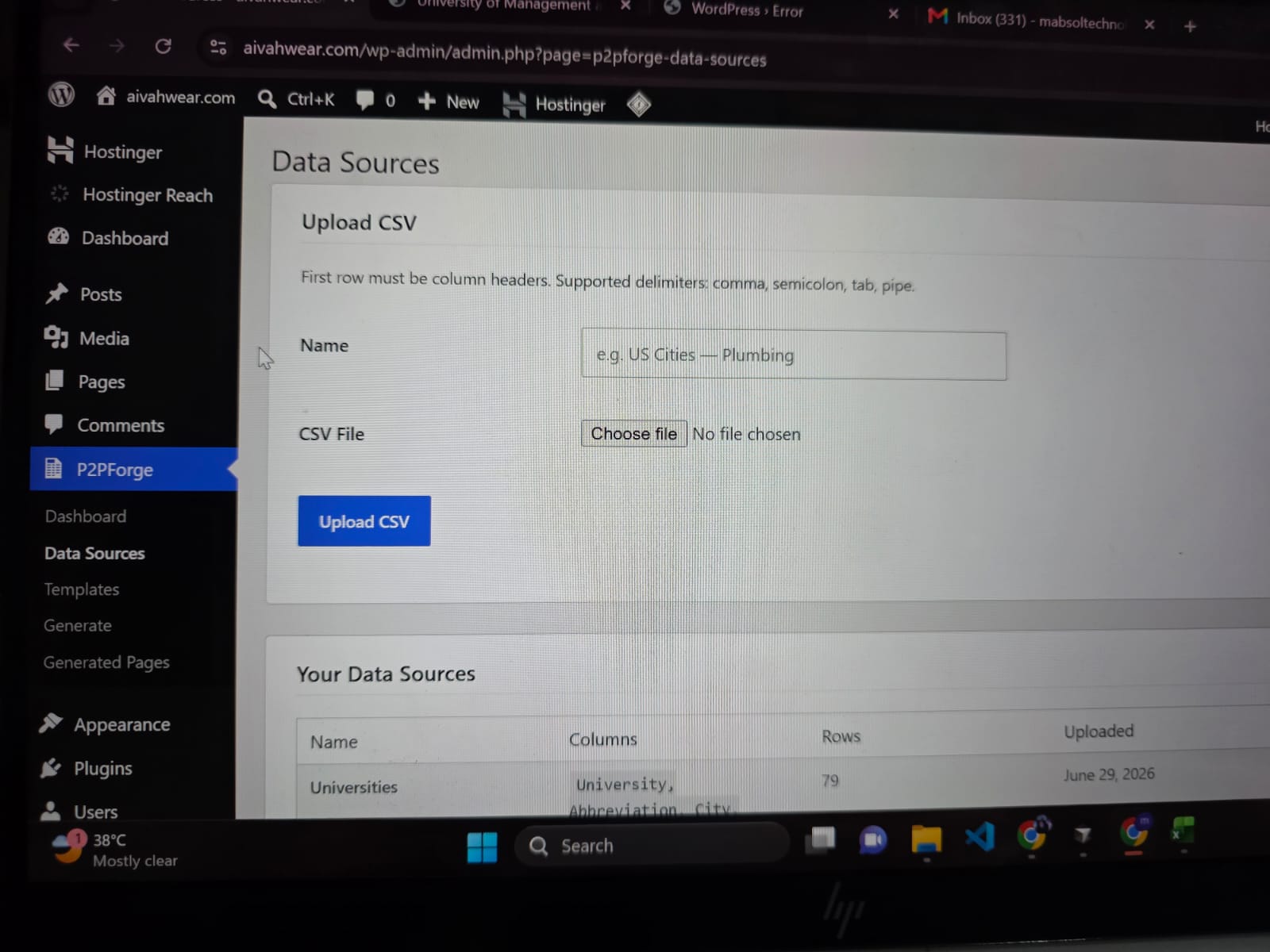
One dashboard, four steps: upload your CSV, build a template, generate pages, review and publish — all inside WP-Admin.
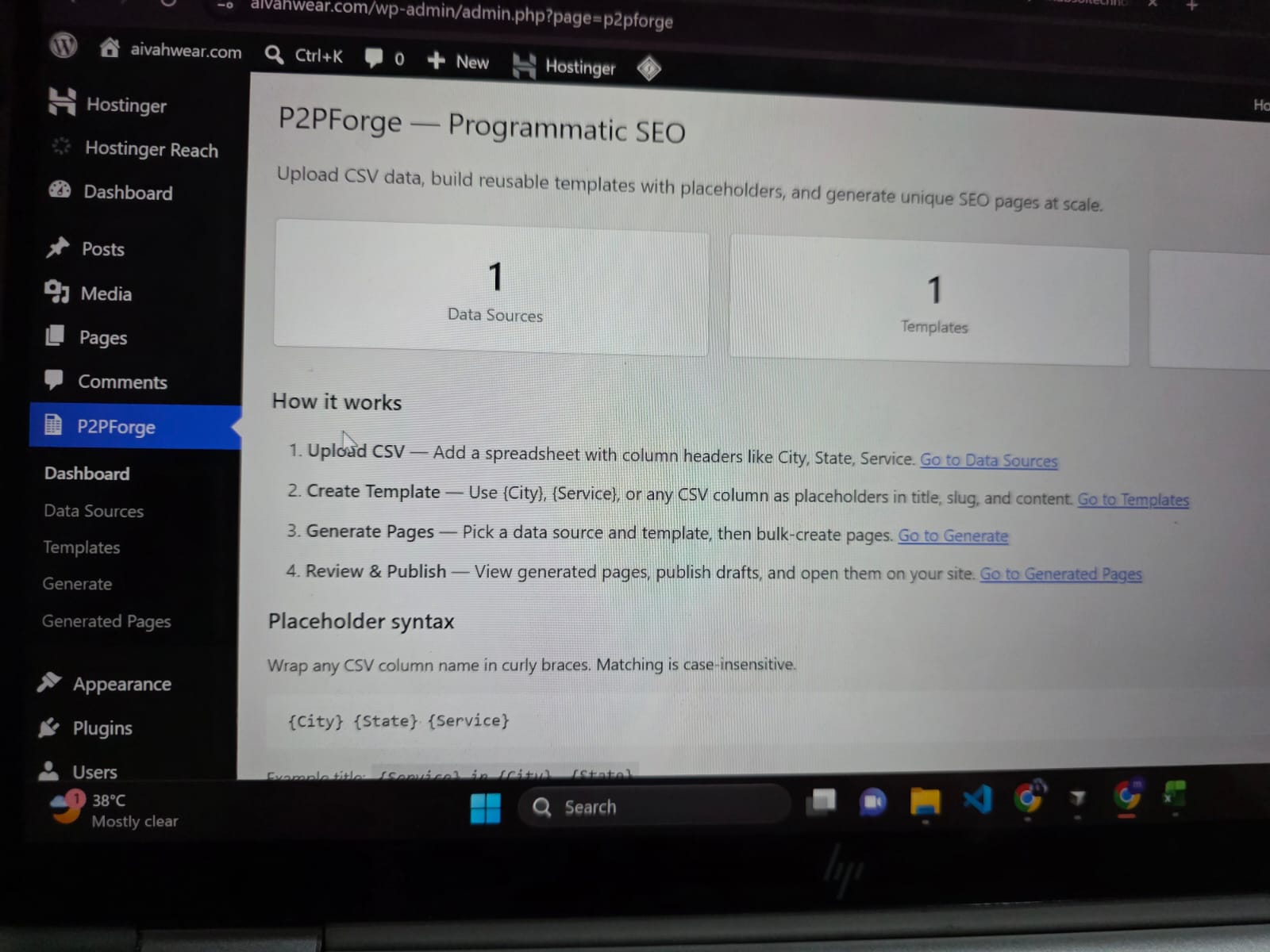
Upload any CSV — name it, drop the file, and it's instantly available as a data source for your templates.
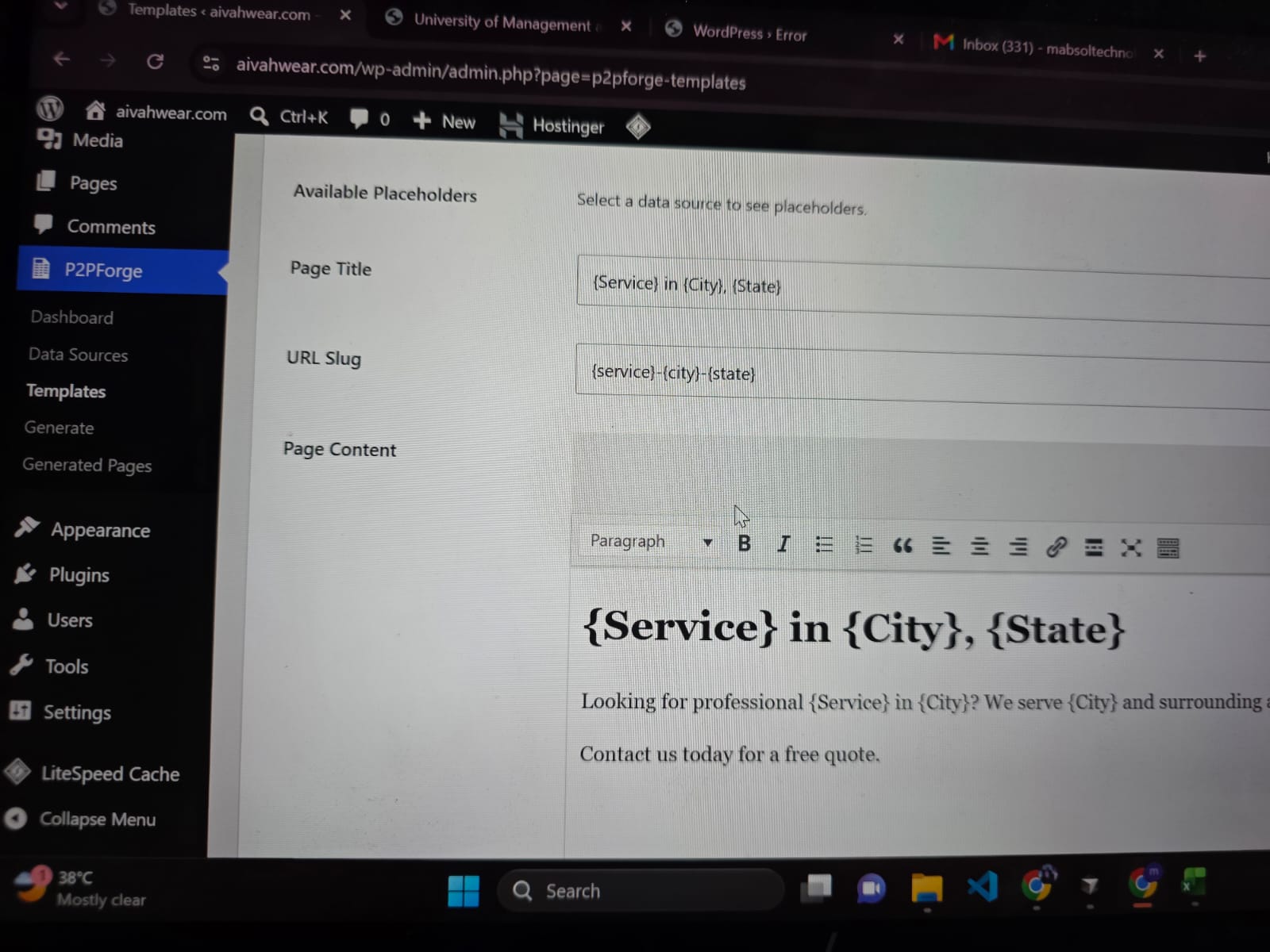
Build a template once using simple {Placeholder} syntax in the title, slug, and content — it pulls straight from your CSV columns.
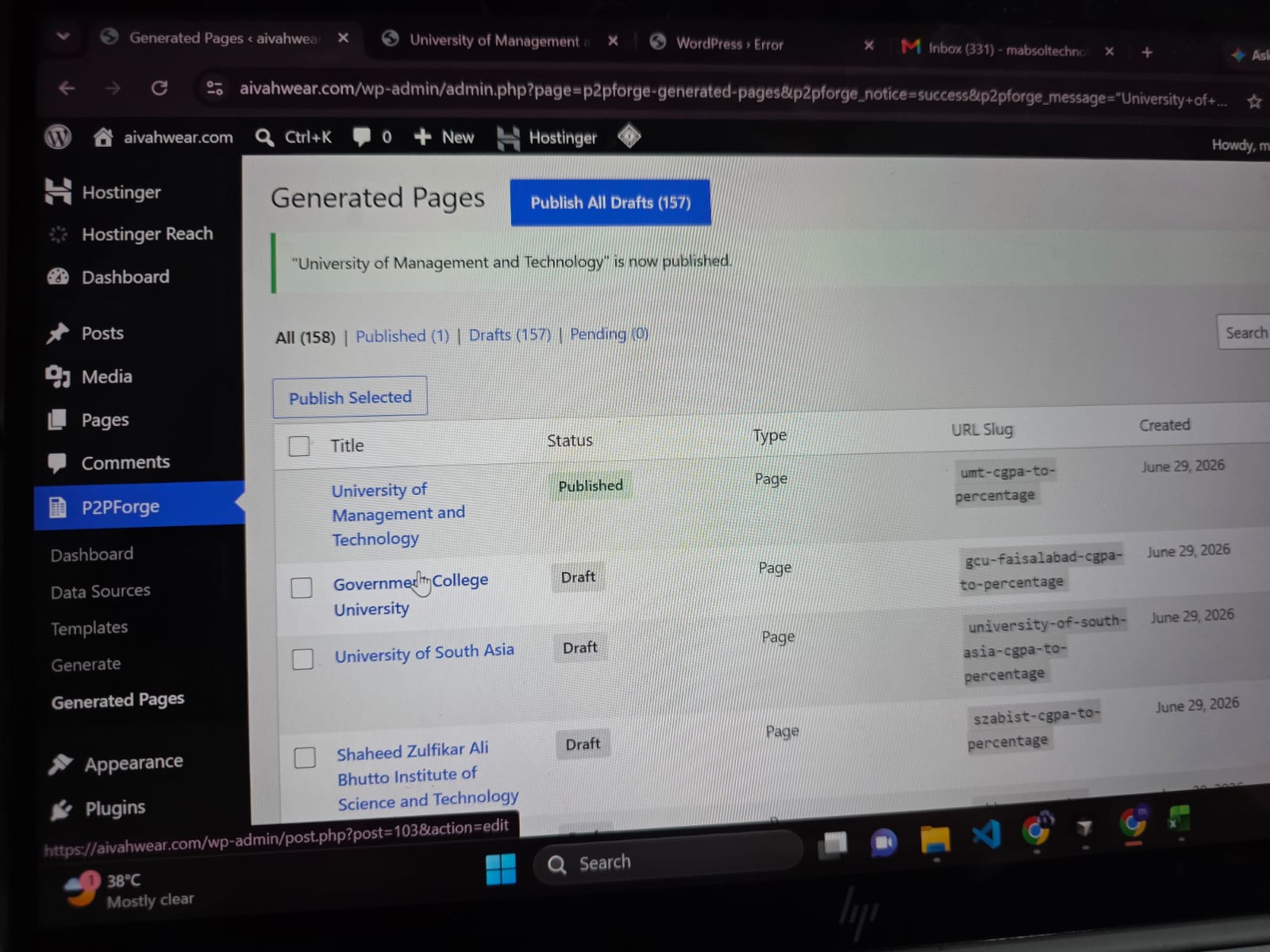
Every generated page lands here as a draft first — review individually or publish all at once when you're ready.
The plugin connects your WordPress site to the platform. It doesn’t generate content itself — it just publishes what your account sends it, natively, as real WordPress posts.
Questions
Is programmatic SEO bad for Google rankings?
Not inherently. Google penalizes thin, low-value, duplicate-intent pages — not the act of generating pages from a template. Sites like Zillow and TripAdvisor run almost entirely on programmatic pages and rank extremely well, because each page answers a genuinely distinct query with real, specific information.
How many pages can I generate at once?
Technically, thousands in a single batch. Practically, you should publish in controlled drips rather than all at once — a sudden spike of thousands of new pages looks unnatural to search engines and is harder to quality-check. A queued, rate-limited rollout is safer than a single bulk dump.
Do I need to know how to code to use programmatic SEO?
No. The data side is a spreadsheet (CSV or Google Sheet), and the page-building side is a template with placeholders. Tools built for this — including ours — handle the generation and publishing without requiring you to write code.
What's the difference between programmatic SEO and just writing more blog posts?
Blog posts are written one at a time, usually targeting one keyword each. Programmatic SEO defines one template and one data source, then generates a unique page per row — so 500 rows of city/service data becomes 500 distinct, individually targeted pages without writing each one by hand.